


A petrochemical complex project rebuffed by Taiwanese two years ago is proving equally unpopular among residents of Pengerang, Malaysia, some of whom have traveled to Taipei to voice their opposition. The visitors said the Taiwanese government should not “dump your unwanted garbage in somebody else’s homeland.”
Members of the Pengerang NGO Alliance and three Johor State legislative assemblymen, accompanied by members of the Changhua Environmental Protection Union and Yunlin County Shallow Waters Aquaculture Association and Democratic Progressive Party Legislator Tien Chiu-chin (田秋堇), protested outside the Presidential Office yesterday, pleading for Taiwanese to be aware of the problem and asking for a response from President Ma Ying-jeou (馬英九).
Kuokuang Petrochemical Technology Co, in which state-owned oil refiner CPC Corp, Taiwan, has a large stake, turned to Pengerang, a small town at the southeastern tip of Malaysia, after its bid to build its eighth naphtha cracker on the coastal wetlands in Changhua County was rejected.
Ee Chin-li (黃俊歷), one of the Malaysian assemblymen, said the environmental impact assessment for the petrochemical project is now in its final stage and while Kuokuang’s investment plan has been in place since 2011, it was not until the beginning of this year that the Malaysian government confirmed the project.
“But the land reclamation and the making of oil fuel tank for the project had already been completed by then,” he said.
“The Malaysian government has to be held responsible, but we would also like to ask President Ma, as [the leader of] the exporting country, to help halt the project,” assemblyman Tan Hong-pin (陳泓賓) said.
“We reject the entry of industries undertaking high pollution-generating and energy-consuming activities,” Tan said.
“Malaysia is not a dump for Taiwan’s wastes,” acting chairman of the Pengerang NGO Alliance Chua Peng-sian (蔡平先) said. “What the residents want is sustainable development, not pollution.”
“More than 3,600 ancestral graves and four temples of local Chinese descendants are to be leveled for the project, some of which date back hundreds of years,” Tan said.
Chua said the grave removals was a disgrace to the world’s Chinese descendants.
Just as Taiwanese environmentalists worried about the threat the complex would pose to the endangered humpback dolphins off Taiwan’s west coast, their Malaysian counterparts say the endangered dugongs inhabiting Malaysian coastal waters and lobsters that thrive off Pengerang would face a similar plight once the petrochemical industry put down its roots.
After Kuokuang’s project was ousted from Taiwan, “is it then okay for it to go to Malaysia to continue polluting the planet?” Tien said.
“People have to rethink the meaning of petrochemicals, as the supply of petroleum is waning, and the health hazards the industry brings about are immense,” she said.
Tien asked for CPC Corp’s to immediately divest itself from the project. She said the corporation should be thinking about the development of renewable energy technologies.

UPGRADE: The Kang Ding-class frigate is replacing its Chaparall missiles with Tien Chien II and Hua Yang VLS, which would provide it with long-range, 360° air defense Taiwan plans to produce 1,200 to 1,376 Hai Chien II missiles (海劍二, Sea Sword II) — also known as TC-2N — to serve as the standard air defense system of the navy’s surface combatant fleet, a source said yesterday. Last week, the Hai Chien II, the naval version of the Tien Kung II missile (天劍二, Sky Sword II), completed a live-fire test in waters off the National Chungshan Institute of Science and Technology’s Jiupeng facility (九鵬) in Pingtung County’s Manjhou Township (滿州). The MIM72 Chaparral and other dated air defense missiles that currently arm Taiwanese ships have inadequate range to combat Chinese

REASONS FOR TRAVEL: An assistant professor said that proposed amendments to penalize drivers if they used drugs overseas would not deter people from traveling People who operate a motor vehicle under the influence of marijuana would have their driver’s license revoked, even if they used the substance while overseas, the Ministry of Transportation and Communications said yesterday, citing proposed amendments to the Road Traffic Management and Penalty Act (道路交通管理處罰條例). The amendments would also authorize the government to revoke the licenses of people determined to have used Category 1 or Category 2 narcotics, even if they were not operating a vehicle while under the influence of drugs, as well as ban them from taking the license test for three years, the ministry said. People aged 18 or

HEAVY WEATHER: Typhoon Jangmi is due to crash straight into the Ryukyus as airlines look to shift flights to larger aircraft or cancel flights to Okinawa entirely Taiwan’s international air carriers announced flight adjustments over the weekend as Typhoon Jangmi is forecast to hit the Ryukyu Islands today and tomorrow. The Central Weather Administration (CWA) upgraded Jangmi from a tropical storm to a typhoon at 8am yesterday, with the eye located 580km south of Naha city. It was moving north at 19kph. Today, China Airlines’ CI-120, CI-121, CI-122 and CI-123 flights between Taoyuan and Naha, Okinawa, have been canceled as well as CI-132 and CI-133 between Kaohsiung and Naha. EVA Air’s BR-112, BR-113, BR-186 and BR-185 flights between Taoyuan and Naha are also canceled. Low-cost carrier Tigerair Taiwan canceled IT-230,
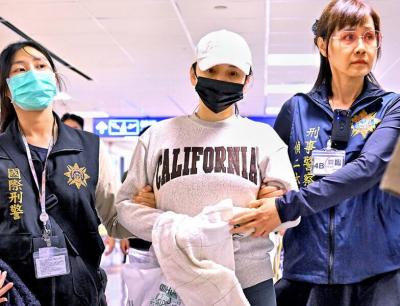
Johanne Liou (劉喬安), a Taiwanese woman who shot to unwanted fame during the Sunflower movement protests in 2014, returned to Taiwan last night after being deported from the US. She is to stand trial in Taiwan for charges involving embezzlement, fraud and drug crimes. The Criminal Investigation Bureau (CIB) said it took her into custody at Taiwan Taoyuan International Airport and would first question her before transferring her to the New Taipei District Prosecutors’ Office. She was arrested upon disembarking a flight from San Francisco that landed shortly before 7pm. Liou absconded to the US in 2019 after jumping bail


 RSS
RSS